


Paper Carrier Tape Cost Factors: What Determines the Final Price?
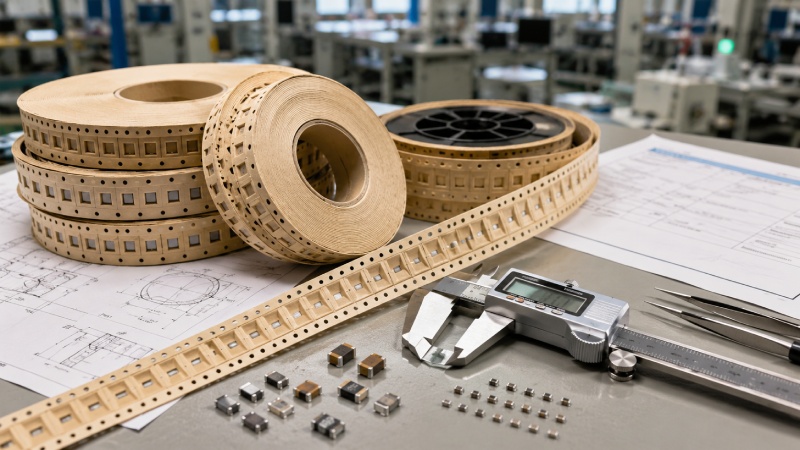
Paper carrier tape is widely used to package small electronic components such as resistors, capacitors, inductors, connectors, and other surface-mount devices. It is often considered a cost-effective alternative to embossed plastic carrier tape, particularly for thin and durable components.
However, there is no universal paper carrier tape price.
Two tapes with the same nominal width may have very different costs because pricing depends on the paper structure, pocket dimensions, production tolerances, tooling requirements, order quantity, inspection level, reel configuration, and delivery terms.
For buyers, understanding these variables makes it easier to compare supplier quotations, avoid unnecessary specifications, and reduce the total packaging cost without affecting component protection or SMT feeding performance.
In general, paper carrier tape cost is determined by:
-
Paper grade and thickness
-
Tape width
-
Pocket size and pitch
-
Punching-tool requirements
-
Dimensional tolerances
-
Order quantity
-
Cover tape and reel configuration
-
Inspection requirements
-
Lead time and shipping method
The lowest price per meter is not always the most economical option. A better purchasing decision considers both the initial quotation and the tape’s performance during component loading, sealing, transportation, and automated assembly.
How Is Paper Carrier Tape Cost Calculated?
A paper carrier tape quotation normally includes several types of cost.
The first is the variable production cost. This includes the paper material, bottom tape or backing layer, machine operating time, labor, inspection, and packaging materials. Wider tapes, thicker paper, and longer production runs directly affect material consumption.
The second category is fixed or one-time cost. A custom project may require engineering evaluation, pocket design, punching-tool development, machine setup, trial production, and sample validation. These costs are more noticeable in small orders because they are divided across fewer meters.
The third category includes commercial and logistics expenses, such as reels, cartons, export packaging, urgent production, freight, and delivery terms.
A simplified pricing model can be expressed as:
Final quotation = material cost + converting cost + tooling and setup allocation + quality-control cost + packaging + logistics
Not every supplier presents these items separately. Buyers should therefore confirm exactly what is included before comparing quotations.
1. Paper Grade, Density, and Thickness
The base paper is one of the most important paper carrier tape cost factors.
Standard paper may be suitable for many common passive components, while demanding applications may require higher-density paper, improved surface smoothness, greater thickness uniformity, antistatic treatment, moisture resistance, or a stronger multilayer structure.
Higher-grade paper usually costs more, but it can reduce problems such as:
-
Paper dust and loose fibers
-
Burrs around punched pockets
-
Dimensional instability
-
Layer separation
-
Weak tape edges
-
Poor cover tape adhesion
Paper thickness must also match the component height and pocket requirements. Using paper that is thicker than necessary increases material consumption, while paper that is too thin may not provide sufficient pocket depth or mechanical strength.
The best option is therefore not always the cheapest paper grade. It is the lowest-cost material that can consistently meet the component, sealing, and feeder requirements.
2. Tape Width and Material Consumption
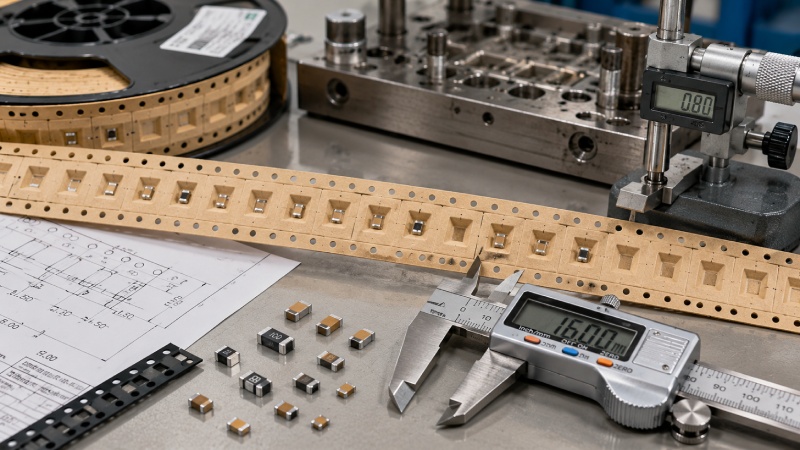
Common carrier tape widths include 8 mm, 12 mm, 16 mm, and 24 mm, although other sizes may be available for special applications.
A wider tape generally costs more per meter because it uses more paper. It may also require larger punching tools, reels, cartons, and storage space.
However, tape width should not be reduced simply to lower the quotation. The selected width must provide enough space for the component pocket, sprocket holes, tape edges, and stable transport through taping and SMT equipment.
An optimized design uses the narrowest practical tape width without compromising pocket strength, component clearance, or feeder compatibility.
3. Pocket Size, Pitch, and Component Geometry
Pocket design can have a major influence on paper carrier tape pricing.
Simple rectangular pockets for standard resistors or capacitors are usually easier to punch than pockets for irregular, asymmetrical, fragile, or orientation-sensitive components.
Important design variables include:
-
Component length, width, and height
-
Pocket length and width
-
Pocket pitch
-
Component orientation
-
Clearance around the component
-
Maximum permitted movement
-
Terminal or surface protection
A smaller pocket pitch may increase the number of components packaged per meter, reducing tape consumption per component. However, the pitch must still maintain adequate strength between pockets and comply with the feeding system.
Complex pockets may require more engineering, specialized tooling, slower production, or additional inspection. This can raise both the initial tooling charge and the production price.
4. Standard Tooling Versus Custom Punching Tools
If a supplier already has a suitable punching tool, the project may avoid or reduce a one-time tooling charge.
A completely new component package may require:
-
Pocket design
-
Tool manufacturing
-
Trial punching
-
Tool adjustment
-
Sample production
-
Dimensional approval
Custom tooling can make the first order appear expensive, especially when the required quantity is small. For repeat or high-volume orders, however, the tooling cost can be distributed across a much larger number of meters.
Before paying for new tooling, buyers should ask the supplier to check its existing tooling library. A standard or slightly modified pocket may satisfy the application at a lower cost.
Tool ownership, maintenance responsibility, storage period, and future reuse should also be confirmed before the order is approved.
5. Dimensional Tolerances
Tighter tolerances normally increase paper carrier tape cost.
High-precision production may require better tooling, slower machine speeds, more frequent adjustment, additional measurement, and stricter scrap control.
Important dimensions include:
-
Tape width
-
Pocket length and width
-
Pocket pitch
-
Sprocket-hole position
-
Pocket-to-sprocket alignment
-
Edge quality
-
Camber
These dimensions affect how accurately the tape moves through taping and placement equipment.
However, specifying the tightest possible tolerance is not always beneficial. Unnecessarily strict requirements increase production cost without necessarily improving component packaging or feeder performance.
The tolerance should match the component size, pick-and-place accuracy, and applicable packaging standard.
6. Order Quantity and MOQ
Order quantity has a strong effect on the cost per meter.
Every production run includes fixed preparation activities such as material setup, machine adjustment, tooling installation, trial punching, and initial inspection. When the order is small, these costs are divided across only a limited number of meters.
As volume increases, the supplier can purchase materials more efficiently, run the machine for longer periods, reduce changeovers, and distribute setup costs across more products.
Buyers should distinguish between:
-
Engineering samples
-
Pilot orders
-
Minimum order quantities
-
Mass-production orders
-
Annual blanket orders
-
Scheduled deliveries
For predictable demand, requesting price tiers based on annual consumption can be more effective than negotiating only the first order price.
A blanket order with scheduled releases may also provide better volume pricing without forcing the buyer to receive or store the entire quantity at once.
7. Cover Tape, Reels, and Packaging Configuration
A quotation may cover only the punched paper carrier tape, or it may include a complete tape-and-reel packaging solution.
Additional items may include:
-
Cover tape
-
Bottom tape
-
Empty reels
-
Component loading
-
Heat sealing
-
Pressure-sensitive sealing
-
Leader and trailer sections
-
Labels
-
Export cartons
Cover tape selection affects both cost and production performance. Heat-activated and pressure-sensitive cover tapes require different materials and sealing processes.
The cover tape must provide stable adhesion and controlled peel force. Poor sealing can cause component loss, contamination, feeder vibration, or unexpected line interruptions.
Reel diameter and meters per reel also affect packaging efficiency. Larger reels may reduce reel-change frequency but can increase carton size, shipping volume, or storage requirements.
8. Inspection and Documentation
Standard factory inspection may be included in the quoted price, while customer-specific testing can add cost.
Additional requirements may include:
-
Full dimensional inspection
-
Automated vision inspection
-
First-article reports
-
Peel-force testing
-
Feeder simulation
-
Material certificates
-
RoHS or REACH documentation
-
Batch traceability
-
Customer-specific inspection reports
A higher inspection level is often justified when components are expensive, extremely small, or used in applications where packaging failure could stop production.
Buyers should define all testing and documentation requirements during the RFQ stage. Adding them after production begins may cause delays, reinspection, or additional charges.
9. Lead Time, Freight, and Delivery Terms
Urgent orders may require expedited engineering, priority production, overtime, or air freight. These factors can significantly increase the final landed cost.
Shipping cost is influenced by:
-
Reel diameter
-
Reel quantity
-
Carton dimensions
-
Total weight
-
Pallet requirements
-
Moisture-protective packaging
-
Shipping method
-
Delivery destination
-
Incoterms
Supplier quotations should be compared using the same delivery term and destination. An ex-factory price and a delivered price cannot be evaluated as if they include the same services.
Paper Carrier Tape Versus Plastic Carrier Tape Cost
Paper carrier tape is generally economical for small, durable, low-profile components. Embossed plastic tape is often selected when the component requires deeper pockets, greater mechanical protection, improved dimensional stability, or specific electrostatic properties.
| Decision Factor | Paper Carrier Tape | Plastic Carrier Tape |
|---|---|---|
| Initial material cost | Usually lower | Usually higher |
| Typical applications | Small passive components | Larger or fragile components |
| Pocket depth | More limited | Greater flexibility |
| Production method | Precision punching | Embossing or thermoforming |
| ESD options | Application-dependent | Broader material options |
| Plastic consumption | Lower | Higher |
Paper should not be selected only because it has a lower initial price. The material must still protect the component and operate reliably during sealing, winding, transportation, and automated placement.
Unit Price Is Not the Total Packaging Cost
A low tape price can become expensive if the product causes problems during production.
Potential hidden costs include:
-
Component loss
-
Paper dust contamination
-
Pocket deformation
-
Tape breakage
-
Unstable cover tape peeling
-
Feeder jams
-
Mis-picks
-
SMT line downtime
-
Emergency replacement orders
-
Supplier requalification
Instead of comparing only the carrier tape price per meter, buyers should evaluate the total packaging cost per usable component.
A more complete calculation includes:
Carrier tape + tooling allocation + cover tape + reel + taping labor + freight + expected scrap + production-loss risk
A slightly higher-quality tape can be more economical if it reduces scrap, improves feeding stability, and prevents production interruptions.
How to Reduce Paper Carrier Tape Cost Without Increasing Risk
The most effective cost reduction usually comes from design and purchasing optimization rather than simply requesting a lower unit price.
First, ask the supplier whether an existing punching tool can be used. Avoiding a new custom tool can substantially reduce first-order cost.
Second, do not overspecify tolerances. Use requirements that support reliable feeding rather than demanding unnecessary precision.
Third, optimize tape width and pocket pitch. Reducing unused material can lower the cost per component without affecting packaging performance.
Fourth, consolidate demand. Annual forecasts, blanket orders, and scheduled releases can improve volume pricing.
Fifth, standardize paper grades, reel sizes, and cover tape across similar products where technically possible.
Finally, validate the design before mass production. Component drawings, pocket samples, sealing tests, and feeder trials can prevent costly redesigns or rejected production lots.
What Is Needed for an Accurate Quotation?
To receive an accurate paper carrier tape quotation, provide:
-
Component drawing
-
Component length, width, height, and weight
-
Required component orientation
-
Tape width and pocket pitch, if known
-
Reel diameter and quantity per reel
-
Cover tape requirements
-
Applicable packaging standard
-
Required inspection level
-
Sample and production quantities
-
Estimated annual demand
-
Delivery destination
-
Target lead time
Incomplete information usually results in a preliminary quotation that may change after engineering review.
Request a Paper Carrier Tape Cost Review
Paper carrier tape cost is influenced by much more than material width or order length. The right supplier should evaluate the component, pocket design, tooling availability, tolerances, sealing method, reel configuration, and annual demand as one complete packaging system.
Submit your component drawing, required quantity, reel specification, packaging standard, and delivery destination for an engineering review. A detailed evaluation can identify existing tooling, unnecessary specifications, and practical opportunities to reduce the total packaging cost while maintaining reliable SMT performance.
Frequently Asked Questions
How much does paper carrier tape cost?
There is no standard price. Cost depends on paper grade, thickness, tape width, pocket design, tooling, tolerance, order quantity, reel configuration, inspection, and shipping.
Is paper carrier tape cheaper than plastic carrier tape?
It is often cheaper for suitable small passive components. Plastic tape may be more appropriate for deep, fragile, sensitive, or irregularly shaped components.
Does custom paper carrier tape require tooling?
Most non-standard pocket designs require a suitable punching tool. An existing tool may eliminate or reduce the tooling charge.
Why are sample orders more expensive per meter?
Sample orders still require engineering, setup, trial production, and inspection. These fixed costs are divided across a very small quantity.
Does a higher order quantity reduce the unit price?
Usually, yes. Larger orders distribute setup costs across more meters and allow more efficient material purchasing and production.
Are cover tape and reels included in the price?
Not always. Buyers should confirm whether the quotation includes punched tape only or the complete cover tape, reel, sealing, and packaging service.
What is the best way to compare supplier quotations?
Compare equivalent specifications, tooling charges, MOQ, included materials, inspection level, lead time, delivery terms, and total landed cost—not only the price per meter.



 Emial
Emial John Mr