





Sustainable Tape and Reel Packaging: A Practical Buyer’s Guide
Sustainability is becoming an increasingly important consideration in electronic component packaging. Component manufacturers, distributors and assembly companies are looking for ways to reduce plastic use, improve packaging efficiency and meet environmental targets without creating new production risks.
However, sustainable tape and reel packaging is not simply a matter of replacing plastic carrier tape with paper. Every element—including the carrier tape, cover tape, reel, labels and shipping carton—must work together to protect components and support stable automated placement.
The most sustainable packaging solution is therefore one that reduces material consumption and waste while maintaining component protection, ESD performance and reliable SMT feeding.
What Is Sustainable Tape and Reel Packaging?
Sustainable tape and reel packaging is a packaging system designed to minimize material use, production waste and unnecessary secondary packaging throughout its lifecycle.
A sustainable solution may use paper carrier tape, optimized embossed plastic tape, recycled-content reels or right-sized cartons. The correct combination depends on the component’s dimensions, shape, fragility, electrical sensitivity and placement requirements.
Sustainability should be evaluated across the complete packaging process rather than judged by one material claim. A carrier tape described as recyclable may still create unnecessary waste if it causes unstable sealing, component movement or frequent reel rejection.
In practical terms, sustainable tape and reel packaging should:
-
Use an appropriate amount of material
-
Protect components during handling and transportation
-
Support stable sealing and peeling
-
Maintain reliable pick-and-place feeding
-
Reduce component damage and rejected reels
-
Improve the number of components packed per reel
-
Make packaging materials easier to identify and separate
Environmental improvements should never compromise the basic purpose of the packaging.
What Makes a Tape-and-Reel System Sustainable?
A sustainable packaging system should address three main areas: material efficiency, operational performance and end-of-use handling.
Reduced Material Consumption
Carrier tape width, pocket pitch and reel diameter should be selected according to the actual component instead of using an unnecessarily large format.
For example, a smaller component may not require a wide carrier tape or a large pocket. Optimizing these dimensions can reduce carrier tape consumption, increase the number of components per reel and lower shipping volume.
Secondary packaging should also be reviewed. Oversized cartons, unnecessary plastic bags and excessive protective inserts increase material use without always improving component protection.
Lower Production Waste
Packaging waste is not limited to discarded carrier tape. Damaged components, rejected reels, broken tape and interrupted placement lines all contribute to the environmental impact of the packaging process.
A low-material packaging solution that creates frequent feeding problems may produce more overall waste than a slightly heavier but more stable alternative.
Pocket accuracy, sealing consistency, winding quality and feeder compatibility are therefore important parts of sustainable packaging design.
Practical End-of-Life Management
The recyclability of a packaging material depends on more than its basic composition. Coatings, adhesives, contamination and mixed-material structures can make recovery more difficult.
Buyers should ask suppliers for clear information about the carrier tape, cover tape and reel materials. Packaging should also be designed so that different materials can be separated where practical.
Local collection and recycling capabilities must be considered before making broad environmental claims.
The Complete Sustainable Tape-and-Reel System
Tape and reel packaging contains several connected elements. Changing one part can affect the performance of the entire system.
| Packaging element | Sustainability opportunity | Technical requirement |
|---|---|---|
| Carrier tape | Reduce material weight or select paper where suitable | Accurate pockets, strength and ESD protection |
| Cover tape | Optimize material and sealing layers | Stable sealing and consistent peel force |
| Reel | Use recycled content or reusable designs | Reliable winding and feeder compatibility |
| Labels | Reduce label size and simplify materials | Clear traceability and readable barcodes |
| Outer carton | Use right-sized cartons and recycled fiber | Adequate stacking and transport protection |
| Protective packaging | Remove unnecessary layers | Match moisture and ESD requirements |
A sustainable system must balance these opportunities with actual component requirements.
For example, reducing cover tape thickness may appear beneficial, but it could cause tearing or unstable peeling. Similarly, eliminating a protective bag may not be appropriate for moisture-sensitive or ESD-sensitive components.
Packaging decisions should be based on testing rather than material preference alone.
Sustainable Carrier Tape Material Options
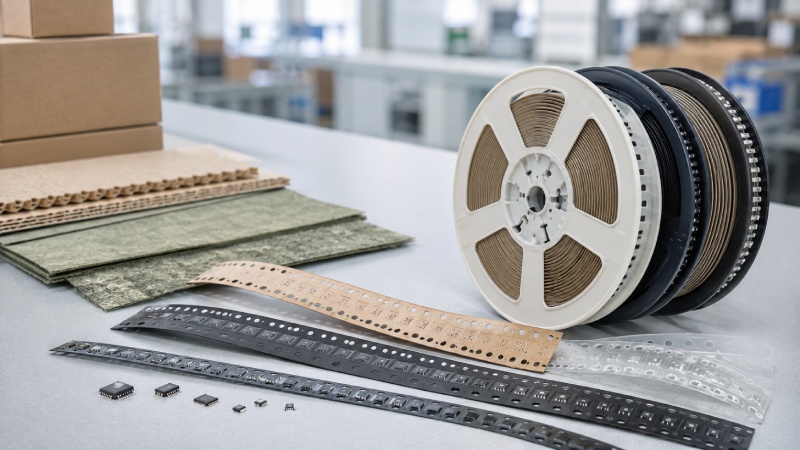
Carrier tape is usually the most visible part of tape and reel packaging. Buyers commonly compare paper carrier tape with embossed plastic carrier tape, but neither option is automatically suitable for every component.
.jpg)
Paper Carrier Tape
Paper carrier tape is often used for small, flat electronic components that do not require deep pockets.
Typical applications include:
-
Resistors
-
Capacitors
-
Inductors
-
Ferrite beads
-
Small passive components
Paper carrier tape can reduce dependence on plastic and may provide an efficient solution for high-volume packaging. It is especially practical when the component has a simple shape and can be securely held in a punched or formed paper pocket.
However, buyers must consider pocket depth, paper strength, humidity exposure, surface treatment and dimensional stability. Some paper carrier tapes also include coatings or supporting layers that affect how the used tape should be handled.
Paper should therefore be selected because it is technically suitable—not only because it appears more environmentally friendly.
Embossed Plastic Carrier Tape
Embossed plastic carrier tape is generally more suitable for components with complex shapes, greater height or sensitive surfaces.
It is commonly used for:
-
Integrated circuits
-
LEDs
-
Sensors
-
Connectors
-
MEMS devices
-
Irregular or fragile components
Plastic carrier tape can form deeper and more complex pockets than paper. This allows the pocket to control component movement and protect terminals, leads or optical surfaces.
Plastic packaging can still support sustainability goals. Opportunities include reducing tape thickness where performance allows, optimizing pocket dimensions, selecting the correct tape width and increasing reel capacity.
A precisely designed plastic pocket may also reduce component damage and placement failures, helping lower total production waste.
Conductive and Antistatic Materials
ESD-sensitive components require appropriate electrical protection throughout packaging, transportation and placement.
Conductive or antistatic carrier tape may be necessary depending on the component’s sensitivity and handling environment. These requirements should not be removed simply to achieve a plastic-reduction target.
The sustainable option is the material that provides the required protection with the least unnecessary material and the lowest risk of component loss.
Sustainability Must Not Compromise SMT Performance
Tape and reel packaging ultimately needs to perform on an automated placement line. Any sustainable packaging proposal should therefore be validated against the same technical standards as conventional packaging.
Pocket Fit
The pocket should control the component without creating excessive pressure or movement. Poor pocket fit may cause components to rotate, flip, tilt or become trapped.
Excessive clearance can also allow terminals to contact the pocket walls during transportation.
Dimensional Accuracy
Tape width, pocket pitch, sprocket-hole position and overall flatness must remain consistent. Dimensional variation can cause feeder misalignment, indexing errors or interruptions during placement.
Cover Tape Performance
The cover tape must seal consistently to the carrier tape and peel smoothly during use.
If the seal is too weak, components may escape during transportation. If it is too strong or inconsistent, the cover tape may tear or create unstable peel force on the placement line.
ESD and Moisture Protection
Packaging must match the component’s ESD and moisture sensitivity. Reducing protective materials without reviewing these requirements can increase component failures and customer complaints.
Packaging that causes damaged components, rejected reels or placement downtime cannot be considered truly sustainable.
How to Reduce Waste in Tape and Reel Packaging
Material substitution is only one way to improve packaging sustainability. In many cases, process optimization creates equally important benefits.
First, tape width and pocket pitch should be matched to the component. Avoiding oversized formats can reduce material use and shipping volume.
Second, the quantity of components per reel should be reviewed. Higher reel utilization may reduce the total number of reels, labels, cartons and handling steps required for an order.
Third, packaging quality should be controlled before mass production. Pocket dimensions, cover tape sealing, reel winding and feeding performance should be inspected to reduce rejected batches.
Secondary packaging should also be right-sized. Reels should be arranged efficiently in cartons while still receiving adequate protection against compression, vibration and moisture.
Finally, packaging materials should be clearly identified. Customers need practical information if carrier tape, cover tape, reels and cartons must be separated after use.
A Practical Evaluation Process
A sustainable packaging project should begin with the component, not with a predetermined material.
1. Define the Component Requirements
Provide the component drawing, dimensions, tolerances, weight, terminal structure, fragility and ESD classification.
A physical sample or 3D model can help the packaging supplier evaluate component orientation and pocket fit.
2. Review the Existing Packaging
Identify current problems such as excessive material, low reel capacity, damaged pockets, unstable peeling or feeder interruptions.
This creates a measurable starting point for improvement.
3. Compare Realistic Material Options
Evaluate paper, standard plastic, antistatic and conductive materials according to actual packaging requirements.
The comparison should include performance, material weight, tooling needs, reel quantity and end-of-use handling.
4. Test the Complete Packaging Combination
Carrier tape should be tested together with the selected cover tape and reel.
Testing may include pocket-fit inspection, sealing trials, peel-force checks, winding evaluation, transportation simulation and feeder testing.
5. Measure the Improvement
Useful indicators include:
-
Material weight per packaged component
-
Number of components per reel
-
Reel rejection rate
-
Component damage rate
-
Shipping volume per order
-
Percentage of identifiable or recoverable materials
These measurements provide a more credible sustainability assessment than a single “eco-friendly” label.
Choosing a Sustainable Packaging Supplier
A capable supplier should be able to evaluate the complete packaging system rather than only sell a standard carrier tape.
The supplier should review component drawings or samples, recommend suitable materials, design the pocket, match the cover tape and verify sealing and feeding performance.
Buyers should also confirm whether the supplier can provide material specifications, ESD information, inspection records and prototype samples before mass production.
Clear communication is especially important. Sustainability targets should be discussed together with component protection, production volume, storage conditions and destination-market requirements.
Need a More Sustainable Tape-and-Reel Solution?
Sustainable tape and reel packaging requires a balance between environmental goals and production reliability. Paper carrier tape may be suitable for some small passive components, while optimized embossed carrier tape may be the better option for complex, fragile or ESD-sensitive devices.
The best solution reduces unnecessary material, improves reel utilization and prevents waste caused by packaging failures.
To evaluate a project, provide your component drawing or sample, current packaging specification, expected order volume, ESD requirements and sustainability objectives. A packaging assessment can then identify practical improvements without compromising component safety or SMT performance.



 Emial
Emial John Mr