
Eco-Friendly Paper Carrier Tape Solutions for Sustainable SMT Packaging
Sustainability is becoming an important purchasing factor throughout the electronics supply chain. Component manufacturers, packaging companies, and assembly plants are under increasing pressure to reduce plastic use, document material sources, and improve packaging efficiency.
Paper carrier tape can help support these goals. For suitable electronic components, it offers a practical alternative to conventional plastic carrier tape while maintaining the consistency required for automated tape-and-reel packaging.
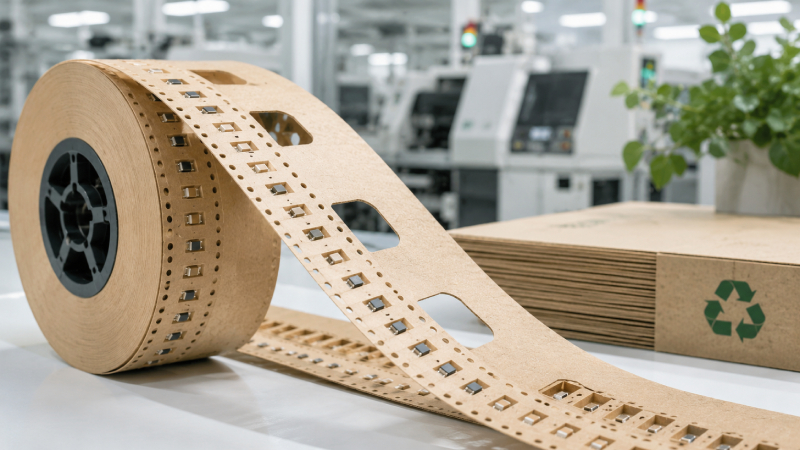
However, paper carrier tape is not automatically sustainable simply because it is made from paper. Its environmental value depends on the fibre source, coatings, adhesives, support layers, production waste, recyclability, and performance during SMT assembly.
The most responsible solution is therefore not always the tape with the lowest plastic content. It is the tape that reduces material impact without increasing component damage, feeder interruptions, rejected reels, or production waste.
Is Paper Carrier Tape an Eco-Friendly Packaging Solution?
Paper carrier tape can be an environmentally preferable option when it is used for the right components and produced with a carefully controlled material structure.
Compared with embossed plastic carrier tape, paper tape can reduce the amount of petroleum-based plastic used in electronic component packaging. It may also incorporate responsibly sourced or recycled paper fibre and can be produced efficiently for high-volume passive components.
A successful eco-friendly solution should meet three conditions:
-
The component must be suitable for paper tape packaging.
-
The tape structure and material claims must be clearly documented.
-
The finished reel must provide stable sealing, peeling, and SMT feeding performance.
If any of these conditions are missing, the environmental benefit may be reduced by damaged components, rejected packaging, production interruptions, or unnecessary material waste.
What Makes Paper Carrier Tape Eco-Friendly?
The environmental performance of paper carrier tape should be evaluated across its complete life cycle rather than judged by appearance alone.
Responsibly Sourced Paper Fibre
The carrier body may be produced using virgin paper fibre, recycled fibre, or a combination of both. Responsibly sourced virgin fibre can provide consistent strength and cleanliness, while recycled content may help reduce demand for new raw materials.
Buyers should ask suppliers to clarify:
-
The source of the paper fibre
-
Whether recycled content is used
-
Whether the recycled content is pre-consumer or post-consumer
-
Whether responsible sourcing documentation is available
-
Whether fibre quality remains stable between production batches
A paper tape made from lower-quality fibre may create dust, dimensional variation, or weak sprocket holes. Sustainability should therefore be balanced with the mechanical and cleanliness requirements of the packaging process.
Reduced Plastic Use
The most obvious environmental advantage of paper carrier tape is its ability to replace the plastic carrier body used in many tape-and-reel systems.
This does not necessarily make the entire package plastic-free. Cover tape, adhesives, surface treatments, bottom support layers, reels, and outer bags may still contain polymer materials.
A responsible supplier should describe the complete construction of the packaging rather than using a broad “plastic-free” claim that applies only to one part of the system.
Efficient Material Use
Environmental improvement also comes from using less material overall.
Optimized pocket design, appropriate tape width, consistent reel winding, and controlled punching can reduce unnecessary paper consumption. Production offcuts and rejected tape should also be managed carefully.
In many cases, reducing defects and improving manufacturing yield creates a greater environmental benefit than making a small change to the fibre composition.
Business Benefits of Sustainable Paper Carrier Tape
Eco-friendly paper carrier tape can offer more than a positive environmental message. It can also provide practical commercial benefits.
Lower Dependence on Plastic Packaging
Companies with plastic-reduction targets can use paper carrier tape for suitable components instead of applying plastic tape across every product category.
This targeted approach makes it possible to reduce plastic consumption without creating unnecessary technical risk.
Support for Customer Sustainability Requirements
Electronics buyers increasingly request information about packaging materials, recycled content, responsible sourcing, and disposal methods.
A clearly documented paper carrier tape solution can help component suppliers respond to these questionnaires with specific information rather than general environmental statements.
Cost-Effective Packaging for High-Volume Components
Paper carrier tape is often suitable for small passive components produced and packaged in large quantities. For these applications, it can provide an efficient balance of material cost, packaging speed, and feeder compatibility.
Stronger Sustainability Communication
Verified material information is easier to communicate to customers. A manufacturer can explain where the paper comes from, how the tape is constructed, and why it was selected for a specific component.
This is more credible than simply describing the packaging as “green” or “environmentally friendly.”
Which Components Are Suitable for Paper Carrier Tape?
Paper carrier tape is most commonly used for small, relatively robust electronic components that do not require deep embossed pockets.
Typical applications may include:
-
Chip resistors
-
Multilayer ceramic capacitors
-
Small inductors
-
Ferrite beads
-
Certain diodes
-
Small passive devices with regular shapes
These components are generally light, compact, and suitable for punched paper pockets.
However, suitability cannot be determined by component category alone. Two components with similar names may have different heights, edge profiles, surface finishes, or sensitivity levels.
Additional evaluation is usually required for:
-
Fragile components
-
Irregularly shaped parts
-
Tall components
-
Components requiring deep pockets
-
Moisture-sensitive devices
-
Parts that are sensitive to fibre particles
-
Static-sensitive components
-
Components requiring high sidewall protection
For these applications, embossed plastic carrier tape may provide better structural protection. In other cases, a specially designed paper structure may still be possible after testing.
To evaluate a component correctly, a carrier tape supplier should receive:
-
A detailed component drawing
-
Length, width, and height
-
Material and surface-finish information
-
Required component orientation
-
Quantity per reel
-
ESD requirements
-
Existing carrier tape specifications
-
Physical samples when available
The more complete the information, the easier it is to design a stable and material-efficient solution.
Can Eco-Friendly Paper Tape Maintain Reliable SMT Performance?
Environmental value is important, but the tape must still work reliably throughout packing, transportation, storage, and automatic placement.
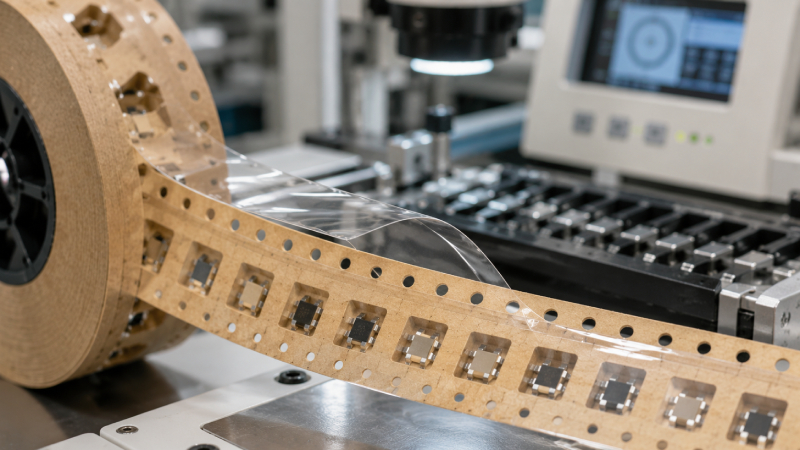
Pocket Accuracy and Component Movement
The pocket must hold the component securely without creating excessive friction.
If the pocket is too large, the component may rotate, flip, tilt, or move vertically. If it is too small, the component may become trapped or damaged during insertion and pickup.
Critical features include:
-
Pocket length and width
-
Pocket depth
-
Pocket pitch
-
Sprocket-hole position
-
Clearance around the component
-
Component orientation
-
Consistency between pockets
Accurate pocket design reduces feeding problems and helps the placement machine pick components consistently.
Tape Strength and Dimensional Stability
Paper tape must remain flat and mechanically stable during reel winding and feeder movement.
Important properties include tape thickness, tensile strength, camber, flatness, and resistance to tearing around sprocket holes.
Humidity should also be considered. Paper can react to changing storage conditions, so material selection and process control are important for maintaining dimensional consistency.
Dust and Surface Cleanliness
Loose fibres and paper particles can affect the packaging environment, components, and feeder equipment.
Dust control depends on fibre quality, punching tools, cutting conditions, surface treatment, and production cleanliness.
A reliable manufacturer should inspect pocket edges, remove loose particles, and maintain clean production and packing areas.
Cover Tape Compatibility
The carrier tape and cover tape must work together as one packaging system.
A weak seal can allow components to escape. An excessively strong seal can create unstable peeling or damage the paper surface. Uneven sealing may cause peel-force variation along the reel.
The supplier should evaluate:
-
Heat-activated or pressure-sensitive cover tape
-
Sealing temperature and pressure
-
Peel-force range
-
Seal consistency
-
Adhesive residue
-
Paper delamination
-
High-speed peeling stability
Sample-reel testing is one of the most effective ways to confirm that the selected combination performs correctly on the customer’s feeder.
Paper Carrier Tape vs Plastic Carrier Tape
Neither material is the best choice for every component.
| Selection Factor | Paper Carrier Tape | Plastic Carrier Tape |
|---|---|---|
| Plastic reduction | Generally higher | Generally lower |
| Typical application | Small, robust components | Wider component range |
| Pocket depth | Usually more limited | Better for deep pockets |
| Moisture resistance | Requires evaluation | Generally stronger |
| Structural protection | Suitable for selected parts | Better for fragile profiles |
| Cost at high volume | Often economical | May be higher |
| Environmental result | Depends on full structure | Depends on resin and recovery options |
Paper tape may provide a better material profile for small passive components. Plastic tape may be the more responsible option when additional protection prevents damage and production waste.
Selecting paper tape for an unsuitable component can increase rejects, damaged parts, line stoppages, and repacking. The environmental cost of these failures may exceed the material saved.
How to Choose a Truly Eco-Friendly Paper Carrier Tape
A structured evaluation process helps buyers separate meaningful improvements from unsupported environmental claims.
1. Confirm Component Compatibility
Review the component’s dimensions, weight, profile, strength, surface condition, orientation, and sensitivity.
Do not assume that an existing plastic pocket can be copied directly into paper.
2. Review the Complete Material Structure
Ask the supplier to explain the materials used in the:
-
Paper carrier body
-
Bottom support layer
-
Surface treatment
-
Adhesive
-
Cover tape
-
Reel
-
Protective packaging
This prevents environmental decisions from being based on only one visible material.
3. Verify Environmental Claims
Useful documents may include:
-
Fibre-sourcing information
-
Recycled-content declarations
-
Responsible sourcing certificates
-
Material composition statements
-
Restricted-substance reports
-
Recycling or disposal guidance
The supplier should also clearly state the scope of each document. A certificate for the factory does not always mean that every product contains certified or recycled material.
4. Check Manufacturing Quality
Review how the supplier controls:
-
Pocket dimensions
-
Sprocket-hole accuracy
-
Tape thickness
-
Camber
-
Burrs and loose fibres
-
Dust levels
-
Cover tape sealing
-
Peel force
-
Reel winding
Stable quality is essential because an environmentally improved material provides little value if it creates packaging failures.
5. Test Sample Reels
Before mass production, run sample reels under realistic conditions.
Evaluate feeder movement, cover tape peeling, component stability, pickup accuracy, dust, pocket damage, and performance at the intended production speed.
6. Compare Total Environmental Cost
The assessment should include more than tape price or material weight.
Consider:
-
Component damage
-
Rejected reels
-
Line downtime
-
Repacking
-
Transportation
-
Storage
-
Disposal
-
Production scrap
-
Packaging efficiency
The best solution is the one that reduces total waste while maintaining reliable output.
A Practical Transition from Plastic to Paper Carrier Tape
Manufacturers do not need to replace every plastic carrier tape immediately.
A controlled transition can begin with small, robust components that require shallow pockets and are already produced in high volumes.
A practical process includes:
-
Identify suitable components currently using plastic tape.
-
Review drawings and packaging requirements.
-
Develop component-specific paper pocket designs.
-
Produce short sample reels.
-
Test them on actual feeders.
-
Compare results with the existing packaging.
-
Approve the final material and dimensions.
-
Expand gradually to similar product families.
Performance data should be tracked during the transition, including feeding interruptions, damaged components, peel variation, packaging scrap, and plastic reduction.
Questions to Ask a Paper Carrier Tape Supplier
Before selecting a supplier, buyers should ask:
-
What type of paper fibre is used?
-
Is recycled content available?
-
Can recycled content be documented?
-
Are coatings or surface treatments applied?
-
What is used for the bottom support layer?
-
How are dust and loose fibres controlled?
-
Which tape widths and pitches are available?
-
How are pocket tolerances inspected?
-
Which cover tapes have been validated?
-
Can custom sample reels be produced?
-
Can the supplier evaluate component drawings?
-
What inspection records are available for production orders?
Clear answers show that the supplier understands both environmental goals and SMT performance.
Frequently Asked Questions
Is paper carrier tape recyclable?
It may be recyclable, but this depends on the complete structure. Coatings, adhesives, support layers, contamination, and local recycling rules can affect whether the tape is accepted.
Is paper carrier tape biodegradable?
The paper fibre may biodegrade under suitable conditions. However, adhesives, coatings, and polymer layers may not behave in the same way. The finished product should not be described as fully biodegradable without supporting evidence.
Can paper carrier tape be used for ESD-sensitive components?
It may be possible when the tape is designed with suitable static-dissipative properties. Surface resistance, component sensitivity, and the complete packaging system must be tested.
Can paper carrier tape meet tape-and-reel standards?
A properly designed paper carrier tape can be manufactured to applicable dimensional and performance requirements. Compliance should be confirmed for the specific component and tape structure.
How can I determine whether my component is suitable?
Provide the component drawing, dimensions, material, orientation, quantity, and ESD requirements to the carrier tape supplier. A sample reel should be tested before mass production.
Choose Sustainability Without Compromising Reliability
Eco-friendly paper carrier tape can reduce plastic use and support more responsible electronics packaging. Its value is greatest when the paper source, material structure, manufacturing quality, and end-use performance are all considered together.
The goal should not be to replace plastic at any cost. It should be to select the lowest-impact packaging solution that protects the component and runs reliably through the SMT process.
Need to evaluate paper carrier tape for your components? Send us your component drawing, dimensions, annual quantity, required tape width, and ESD information. Our team can recommend a suitable paper tape structure and prepare samples for feeding tests.



 Emial
Emial John Mr