

Recyclable Carrier Tape Packaging for Sustainable SMT Components
Recyclable carrier tape packaging is becoming an important choice for electronic component suppliers that want to reduce packaging waste while keeping components safe, organized, and ready for automated SMT assembly. For buyers, the challenge is simple: packaging needs to support sustainability goals, but it cannot create feeding problems, unstable pocket fit, ESD risk, or component damage.
That is why recyclable carrier tape should not be selected only by material name. A good solution must balance material recyclability, component protection, pocket accuracy, cover tape matching, and real production performance. If you are comparing different carrier tape packaging solutions, this guide will help you understand what to check before choosing recyclable carrier tape for your components.
What Is Recyclable Carrier Tape Packaging?
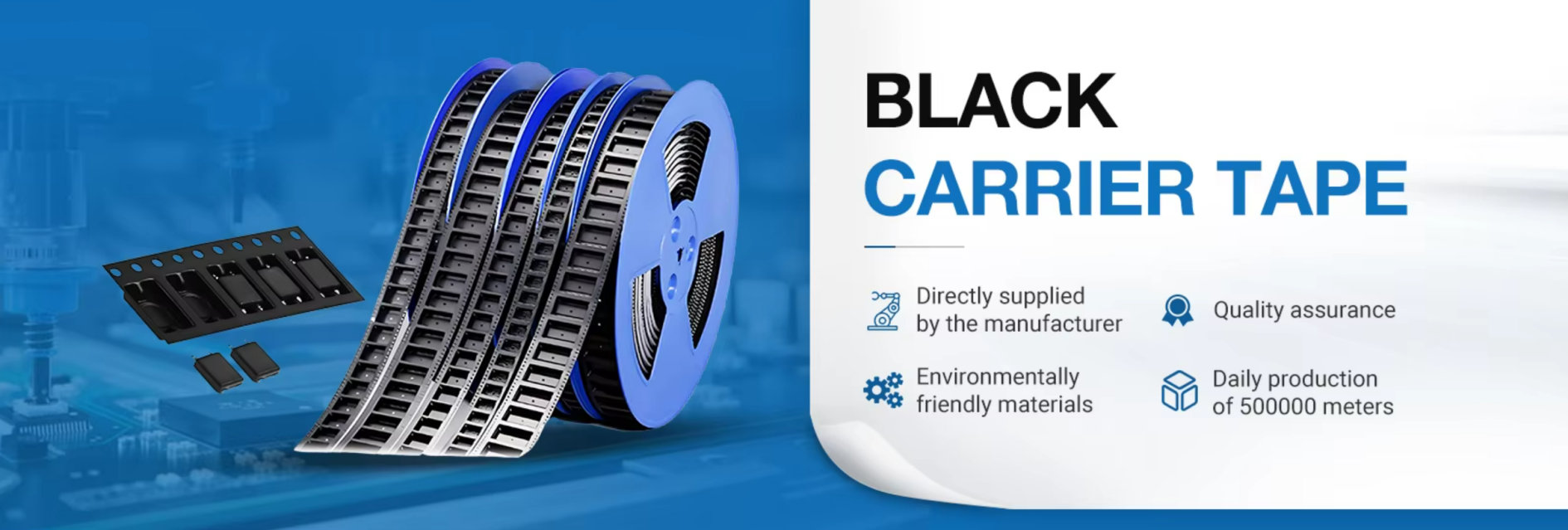
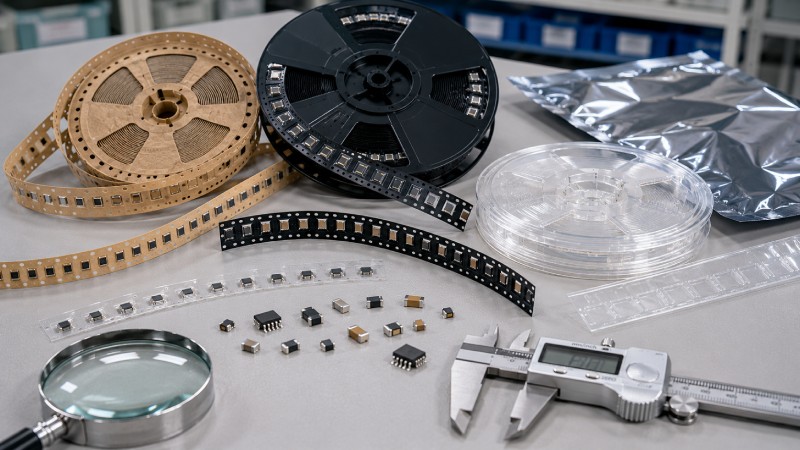
Carrier tape is used to hold electronic components in individual pockets for tape-and-reel packaging. These pockets keep components in the correct position during storage, transportation, and SMT feeding. Recyclable carrier tape packaging refers to carrier tape made from materials that may be collected, sorted, and processed through suitable recycling channels after use.
However, “recyclable” does not always mean the same thing in every market. Recyclability depends on the base material, coatings, contamination level, labels, adhesives, local recycling systems, and whether the packaging can be properly separated from other materials.
It is also important not to confuse recyclable packaging with biodegradable, compostable, or recycled-content packaging. Recyclable means the material has the potential to be processed into new material. Recycled content means the product is made partly or fully from recovered materials. Biodegradable and compostable materials follow different environmental paths and are not always suitable for electronic component packaging.
For SMT supply chains, the most important question is not only “Can this material be recycled?” but also “Can this packaging protect my components and run smoothly on the SMT line?”
Why Recyclability Matters in Electronic Component Packaging
Electronics manufacturers and OEM buyers are paying more attention to packaging sustainability. In high-volume production, tape-and-reel packaging can generate a large amount of used carrier tape, cover tape, reels, labels, and outer packaging materials. For component suppliers, recyclable packaging can help reduce waste pressure and support customers’ sustainability expectations.
At the same time, buyers cannot accept packaging that looks environmentally friendly but fails in real use. If the carrier tape causes tilted components, poor pickup, unstable feeding, contamination, or damaged leads, the cost of production problems will be much higher than the value of a sustainability claim.
This is why recyclable carrier tape packaging should be treated as a complete packaging system. The material must match the component. The pocket design must keep the part stable. The cover tape must seal and peel consistently. If the component is ESD-sensitive, the packaging must also provide suitable static control.
For component suppliers, recyclable packaging is not only about reducing waste. It can also become a stronger selling point when working with global OEMs, contract manufacturers, and sourcing teams that care about both quality and environmental responsibility.
Common Materials Used for Recyclable Carrier Tape Packaging
Different components need different carrier tape materials. The best option depends on component size, shape, height, sensitivity, and SMT feeding requirements.
Paper Carrier Tape
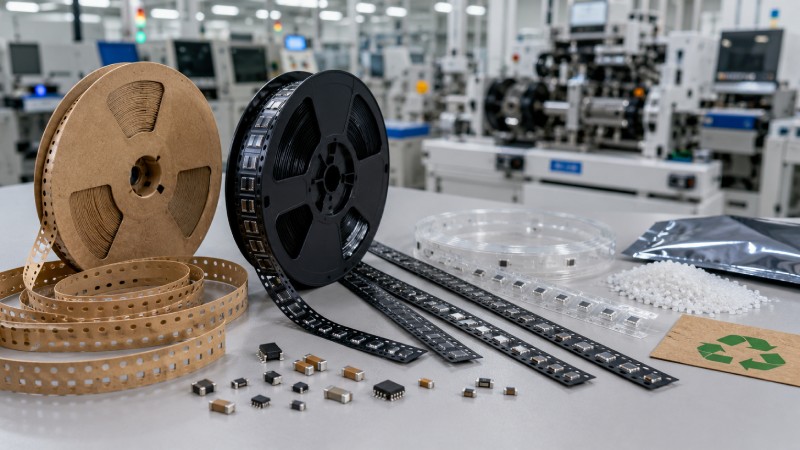
Paper carrier tape is commonly used for small passive components such as resistors, capacitors, and some simple SMD components. It is often selected when the component has a relatively low profile and does not need a deep embossed pocket.
The main advantage of paper carrier tape is that it offers a practical sustainability profile for suitable components. It is lightweight, cost-effective, and widely used in passive component packaging. For buyers who need a recyclable or lower-waste packaging direction, paper carrier tape is often one of the first options to evaluate.
However, paper carrier tape is not suitable for every application. Components with irregular shapes, taller bodies, fragile surfaces, or strict orientation requirements may need stronger pocket support. Moisture control, dimensional stability, and pocket precision should also be considered before choosing paper tape for mass production.
Recyclable Plastic Carrier Tape
For ICs, LEDs, connectors, sensors, MEMS components, and other parts with more complex packaging needs, plastic carrier tape is often more suitable. In many cases, embossed carrier tape provides better pocket depth, stronger component support, and more accurate positioning.
Recyclable plastic carrier tape may be made from materials that can be processed through appropriate recycling channels, depending on the resin type and local recycling conditions. It is especially useful when the component needs a custom pocket shape, ESD protection, or stable orientation during SMT feeding.
The limitation is that plastic recyclability can be affected by mixed materials, coatings, anti-static treatments, labels, adhesives, and contamination. Buyers should avoid vague claims such as “100% recyclable” without understanding what material is being used and whether it fits the customer’s recycling process.
Mono-Material Packaging Approach
Recyclability is often easier when the packaging system uses fewer mixed materials. In tape-and-reel packaging, buyers should consider not only the carrier tape, but also the cover tape, reel, labels, bags, and outer cartons.
A cleaner material structure can make sorting and recovery easier. For example, reducing unnecessary mixed layers or choosing compatible packaging materials may improve the overall recycling potential. This is why recyclable carrier tape should be discussed as part of a complete packaging solution, not as a single isolated product.
Recyclable Carrier Tape vs Conventional Carrier Tape
Recyclable carrier tape and conventional carrier tape may look similar, but the selection logic is different.
Conventional carrier tape is usually selected mainly for cost, availability, and packaging performance. Recyclable carrier tape also needs to meet those requirements, but it adds another layer of decision-making: material recovery and waste reduction.
For buyers, the key is to avoid choosing recyclable tape only for marketing reasons. If the tape cannot provide reliable SMT performance, the packaging will fail its main purpose.
| Factor | Recyclable Carrier Tape Packaging | Conventional Carrier Tape Packaging |
|---|---|---|
| Main focus | Lower waste and material recovery | Standard packaging function |
| Buyer value | Supports sustainability and supplier qualification | Familiar and widely used |
| Material choice | Requires more attention to recyclability | Often selected by cost and performance |
| SMT performance | Must still meet feeding and pocket requirements | Must meet normal production requirements |
| Main risk | Over-claiming recyclability | Higher packaging waste |
| Best use case | Sustainability-focused OEM supply chains | General component packaging |
The best recyclable carrier tape is not the one with the strongest environmental claim. It is the one that supports recycling goals while still protecting the component and running smoothly in production.
How to Choose the Right Recyclable Carrier Tape for Your Components
Choosing recyclable carrier tape starts with the component itself. Buyers should first review the component’s length, width, height, weight, shape, tolerance, fragile areas, and orientation requirements. A small chip resistor and a tall connector cannot use the same packaging logic.
Next, check SMT feeding requirements. Tape width, pocket pitch, pocket depth, reel size, cover tape peel force, and feeding direction all affect production stability. Even a recyclable material can cause problems if the pocket design is not accurate.
Protection requirements are also critical. Some components need ESD-safe packaging. Others need protection from dust, vibration, surface scratches, or movement inside the pocket. For LEDs, lens protection and orientation are important. For MEMS and sensors, cleanliness and stable positioning may be more important. For connectors, the pocket may need to prevent pin deformation or tilting.
Finally, evaluate the recycling path. Ask whether the material is accepted in the target market, whether the carrier tape can be separated from the cover tape and reel, and whether coatings or labels reduce recyclability. A supplier should be able to explain the material choice clearly instead of only using general eco-friendly wording.
If you are unsure whether paper tape or recyclable embossed plastic tape is better for your component, Jiushuo can review your drawing or sample and recommend a suitable structure.
Component Types That Can Use Recyclable Carrier Tape Packaging
Recyclable carrier tape packaging can be used for many electronic components, but the material and design should be selected according to the application.
Small passive components are often good candidates for paper carrier tape when the pocket depth and protection needs are simple. Resistors, capacitors, and inductors may use paper tape when the size and feeding requirements are suitable.
IC chips and semiconductor components usually require more accurate pocket design. For these applications, embossed carrier tape is often preferred because it can provide better component positioning, ESD control, and protection during SMT feeding. Buyers working with semiconductor parts may also consider dedicated carrier tape for IC chip packaging.
LEDs may need carrier tape that protects the lens area and keeps the component correctly oriented. Poor pocket design can cause rotation, surface contact, or unstable pickup. A well-designed LED carrier tape helps reduce these risks while supporting tape-and-reel automation.
Connectors and terminals often have uneven shapes, pins, or taller bodies. These parts commonly require custom embossed pockets to avoid loose fit, bent pins, or feeding issues. Sensors and MEMS components may also require careful pocket design, cleanliness control, and stable orientation because of their sensitive structures.
Key Design Factors That Affect Recyclability and Performance
A recyclable carrier tape solution must still meet packaging performance requirements. Several design factors should be checked before mass production.
First, material consistency matters. A stable material structure helps maintain pocket dimensions and may also support better sorting after use. Second, pocket accuracy is essential. If the pocket is too loose, the component may rotate or tilt. If it is too tight, loading and pickup may become difficult.
Cover tape compatibility is another important factor. The cover tape must seal properly during packaging and peel consistently during SMT feeding. If the peel force is unstable, the SMT line may experience pickup errors or interruptions.
ESD control should not be ignored. Many electronic components are sensitive to static electricity, so recyclable packaging may still need anti-static or static-dissipative performance.
Cleanliness is also important for ICs, LEDs, sensors, and MEMS components. Dust, particles, or surface contamination can create quality risks, especially for sensitive parts.
Finally, buyers may need documentation. Material information, packaging specifications, testing results, and compliance-related documents can help support internal approval and customer qualification.
Buyer Checklist Before Requesting a Recyclable Carrier Tape Quote
Before requesting a quote, prepare the following details:
-
Component drawing or 3D file
-
Component length, width, height, and tolerance
-
Component weight and fragile areas
-
Required tape width and pitch
-
ESD sensitivity
-
Preferred material, such as paper, PET, PS, PC, or other options
-
Reel size and quantity per reel
-
Cover tape requirements
-
Monthly or annual packaging volume
-
Target market or customer sustainability requirements
-
Sampling and testing needs
Providing these details allows the supplier to recommend a more accurate packaging solution. It also reduces the risk of choosing a recyclable material that does not match the component or SMT process.
Common Mistakes When Choosing Recyclable Carrier Tape Packaging
One common mistake is choosing a material only because it sounds environmentally friendly. A recyclable material is not useful if it cannot hold the component correctly or pass feeding tests.
Another mistake is using paper carrier tape for components that need deeper pockets or stronger protection. Paper tape is practical for many small components, but it is not a universal solution.
Some buyers also forget about cover tape compatibility. Even if the carrier tape is well designed, poor sealing or unstable peel force can still cause production issues.
Over-claiming recyclability is another risk. Recyclability should be based on material structure and real recycling conditions, not only marketing language.
The safest approach is to test the packaging before mass production and confirm that the material, pocket design, cover tape, reel, and SMT feeding performance all work together.
How Jiushuo Supports Recyclable Carrier Tape Packaging Projects
Jiushuo helps electronic component suppliers choose carrier tape packaging based on component structure, protection needs, and production requirements. Whether your project needs paper carrier tape, recyclable plastic carrier tape, or custom embossed carrier tape, the packaging should be designed around real component behavior.
Jiushuo can support material recommendation, custom pocket design, cover tape matching, sample testing, and tape-and-reel packaging advice for passive components, ICs, LEDs, connectors, sensors, MEMS components, and other SMD parts.
If your customer is asking for more sustainable packaging, Jiushuo can help you evaluate practical recyclable carrier tape options without sacrificing SMT reliability.
FAQ About Recyclable Carrier Tape Packaging
Is carrier tape recyclable?
Some carrier tape materials may be recyclable, but recyclability depends on material type, coatings, contamination, and local recycling capability. Buyers should confirm the material and recycling path instead of relying only on general claims.
Is paper carrier tape more recyclable than plastic carrier tape?
Paper carrier tape often has a stronger sustainability advantage for suitable components, especially small passive parts. However, plastic embossed tape may be necessary for complex, tall, fragile, or ESD-sensitive components.
Can recyclable carrier tape still protect electronic components?
Yes. If the material, pocket design, cover tape, and ESD properties are properly selected, recyclable carrier tape can still provide stable protection and SMT feeding performance.
Does recyclable carrier tape affect SMT feeding?
It should not affect feeding if the tape is designed correctly. Tape width, pitch, pocket depth, cover tape peel force, and reel quality must all be controlled.
Can recyclable carrier tape be customized?
Yes. Custom pocket design is often required for components with special shapes, fragile leads, strict orientation needs, or unusual height.
What information should I provide for a quote?
You should provide component drawings, dimensions, ESD requirements, material preference, tape width, pitch, reel size, quantity, and target packaging requirements.
Conclusion
Recyclable carrier tape packaging helps electronic component suppliers reduce packaging waste and support customer sustainability goals. But recyclability should never come at the cost of component protection, pocket stability, or SMT feeding reliability.
The right solution depends on your component type, material choice, pocket design, ESD needs, cover tape matching, and actual recycling conditions. If you are looking for recyclable carrier tape packaging for your components, Jiushuo can help evaluate the right material and design for your application.
Contact Jiushuo to request a recyclable carrier tape packaging quote and get a suitable material, pocket design, and tape-and-reel recommendation.



 Emial
Emial John Mr