

Carrier Tape Dimensions Explained: Width, Pitch & SMT Compatibility Guide
Why Carrier Tape Dimensions Matter in SMT Packaging
In SMT packaging, carrier tape dimensions are not isolated mechanical numbers—they are system-level parameters that directly affect feeding stability, placement accuracy, and line efficiency. A carrier tape does not function on its own; it operates as an integrated part of the SMT feeding system, interacting continuously with feeders, nozzles, and pick-and-place equipment.
When dimensions are mismatched, even slightly, the result is rarely limited to cosmetic issues. Common consequences include mis-pick events, tape jamming, component rotation errors, and unplanned downtime. These problems are often misattributed to feeder quality or machine speed, when the root cause is dimensional incompatibility within the tape system itself.
Width, pitch, and pocket geometry must work together in a coordinated way. Changing one parameter without understanding its relationship to the others can destabilize the entire feeding process.

Overview of Carrier Tape Dimensions
Carrier tape dimensions can be understood as a dimensional map rather than a list of independent measurements. In SMT packaging, each dimensional element defines how the tape interacts with feeders, cover tape, and placement equipment throughout the entire tape-and-reel process.
At the most basic level, tape width defines which feeder platform the carrier tape can run on and how much structural support is available for the pocket area. Pocket spacing (pitch) determines the rhythm at which components are presented to the pick-and-place nozzle, directly influencing feeding synchronization. Pocket size and depth control how components are seated and constrained during transport, while sprocket hole alignment ensures accurate indexing and repeatable advancement inside the feeder.
These dimensions are not evaluated in isolation during engineering design. Instead, they form a coordinated system that must remain consistent from tape forming through final SMT placement. Understanding this dimensional framework—before looking at detailed specifications or standards—helps explain why carrier tape design errors often surface as feeding issues rather than obvious dimensional defects.
Carrier Tape Width Explained
Carrier tape width plays a central role in determining feeder compatibility and structural stability during SMT operations. From an engineering perspective, width is not chosen solely to “fit” a component; it defines how the tape is guided, supported, and restrained inside the feeder system.
A common misconception is that smaller components always necessitate narrower carrier tape. In practice, component size and tape width are not in a strict 1:1 relationship. Narrow tapes may lack sufficient sidewall rigidity, leading to pocket deformation, inconsistent cover tape sealing, or instability at higher feeding speeds. In contrast, a slightly wider tape can provide better mechanical support for the pocket area, even when handling small or lightweight components.
Tape width also affects how forming forces are distributed during embossing and how consistently pocket geometry is maintained along the tape length. Selecting width therefore involves balancing feeder constraints, pocket integrity, and process stability—not simply minimizing material usage.
Carrier Tape Pitch Explained
Carrier tape pitch refers to the center-to-center spacing between adjacent pockets along the tape length. From an engineering standpoint, pitch defines the timing relationship between tape movement and component pickup within the SMT feeding process.
Rather than being a simple spacing choice, pitch directly affects feeding smoothness and placement repeatability. If pitch alignment does not match feeder indexing behavior, components may arrive at the pickup point too early or too late, increasing the risk of mis-picks or nozzle hesitation. At higher production speeds, even small pitch inconsistencies can amplify into visible feeding instability.
Pitch is also one of the core variables that governs overall SMT reliability because it links mechanical tape advancement with electronic placement control. This is why pitch is treated as a system-critical parameter, not just a dimensional attribute of the tape itself.
Detailed pitch definitions, configurations, and engineering considerations are intentionally covered in a dedicated resource.
How Width, Pitch and Pocket Work Together
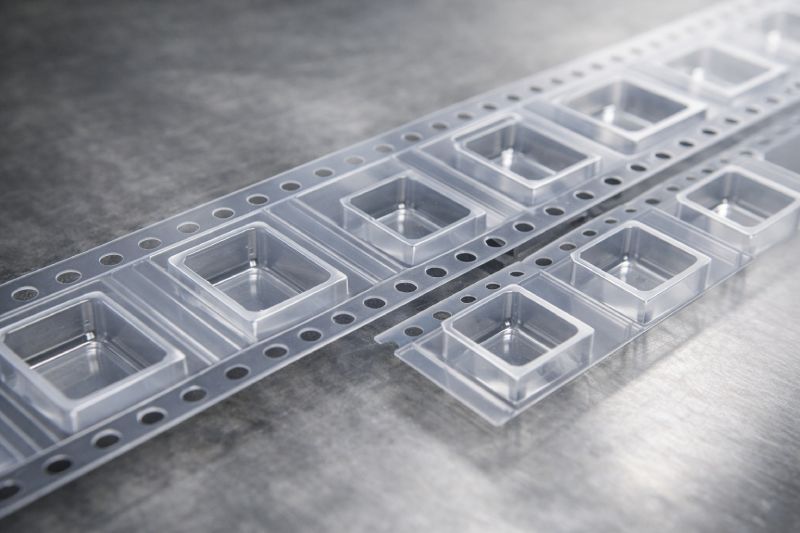
In carrier tape engineering, width, pitch, and pocket design should never be treated as independent variables. Each parameter influences the others, and stable SMT feeding is only achieved when all three are considered together as a unified system.
Tape width defines the available structural envelope. Within that envelope, pocket geometry must be designed to maintain shape integrity during forming, sealing, and feeding. Pitch then determines how frequently that pocket structure is repeated and how forces are distributed as the tape advances through the feeder. A change in pitch without corresponding adjustments to pocket depth or wall thickness can introduce deformation or inconsistent component positioning.
Likewise, pocket design often drives width decisions rather than the reverse. Components with unusual outlines, tight coplanarity requirements, or sensitivity to movement may necessitate wider tapes to support more robust pocket structures at a given pitch. This interdependency is why engineering-focused design workflows evaluate width, pitch, and pocket geometry simultaneously.
Standards and Compatibility Considerations
Industry standards play an important role in establishing a common reference for carrier tape dimensions, but they are often misunderstood in practical SMT applications. Specifications such as EIA-481 exist to define dimensional frameworks that promote feeder compatibility and interchangeability across equipment platforms.
However, many dimension-related feeding issues do not arise because a tape “violates” the standard. Instead, they stem from incorrect interpretation or incomplete application of those guidelines. Standards describe acceptable ranges and relationships, but they cannot account for every component geometry, material behavior, or production condition.
In real-world engineering, compatibility depends on how well the tape design aligns with the specific feeder mechanism, placement speed, and handling environment—not just whether it nominally follows a published specification. Understanding the intent behind standards, rather than treating them as rigid checklists, is essential for avoiding false assumptions in carrier tape design and selection.
Common Dimension-Related Issues in SMT Feeding
Many SMT feeding problems can be traced back to dimensional interactions within the carrier tape system rather than equipment faults. Feeding instability is often the first visible symptom, typically caused by subtle mismatches between tape width, pocket rigidity, and feeder guide constraints. When the tape is insufficiently supported, consistent indexing becomes difficult to maintain.
Component rotation can occur when pocket dimensions do not adequately control part orientation relative to pitch progression. Even if components appear secure during transport, minor clearance issues may allow movement during acceleration or deceleration inside the feeder.
Pocket deformation is another frequent issue, especially when width and pocket depth are poorly balanced. Deformed pockets can alter component height or seating angle at the pickup point, increasing placement variability. Finally, feeder mismatch arises when nominally compatible tape dimensions fail to align with real-world feeder tolerances, leading to intermittent jams or skipped advances.
These issues highlight why dimensional understanding is critical before attempting process-level adjustments.
When Custom Carrier Tape Dimensions Are Required
Standard carrier tape dimensions are suitable for many common components, but certain production conditions make custom carrier tape design necessary. One clear indicator is the use of non-standard components—parts with irregular outlines, asymmetric profiles, fragile terminations, or atypical thickness that cannot be reliably constrained by generic pocket designs.
Custom dimensions are also frequently required in high-speed SMT lines, where marginal dimensional tolerance that is acceptable at lower speeds becomes a source of instability. As placement rates increase, the interaction between width, pitch, and pocket rigidity becomes more sensitive, leaving less margin for compromise.
In yield-sensitive production, even small variations in component seating or pickup height can translate into measurable defect rates. In these cases, tailoring tape width, pitch relationships, and pocket geometry together allows the carrier tape to be optimized for both mechanical stability and process consistency.
When these conditions exist, standard selection rules are no longer sufficient. Engineering-driven customization becomes the most reliable path forward.
Summary
Carrier tape dimensions should be understood as a coordinated system, not a collection of independent measurements. Width, pitch, and pocket geometry work together to determine feeding stability, placement accuracy, and overall SMT reliability. When any one parameter is evaluated in isolation, the risk of mis-picks, rotation, or feeder interruption increases.
A clear dimensional mindset helps distinguish true root causes from secondary symptoms on the SMT line. Rather than adjusting machines to compensate for tape behavior, engineers can achieve more consistent results by aligning tape dimensions with feeder mechanics and production goals.



 Emial
Emial John Mr