


Paper Carrier Tape vs Plastic Carrier Tape: How to Choose
Choosing between paper carrier tape and plastic carrier tape is not simply a question of price or material preference.
Paper carrier tape can be an efficient solution for many small, stable, high-volume components. Plastic carrier tape offers greater flexibility for deeper pockets, irregular shapes, visual inspection, and specialized electrostatic discharge requirements. Neither option is automatically better. The correct choice depends on component geometry, packaging conditions, production equipment, and total cost of use.
.jpg)
Paper or Plastic Carrier Tape? The Quick Answer
Paper carrier tape is generally suitable for small, low-profile components that can be held securely in punched or pressed cavities.
Plastic carrier tape is usually evaluated when a component requires a deeper three-dimensional pocket, stronger structural protection, greater design flexibility, or controlled electrical properties.
The final decision should be based on component drawings, pocket fit, ESD requirements, cover tape compatibility, and feeder testing. Material alone does not determine packaging performance.
What Is the Structural Difference?
Paper carrier tape normally uses punched, partially punched, or pressed cavities. Some designs include a bottom support layer that closes the cavity. The pocket shape depends on paper thickness, density, treatment, and the manufacturing method.
Plastic carrier tape is normally thermoformed or embossed. Heat and forming tools create a three-dimensional pocket in the plastic film, supporting a wider range of pocket depths and component geometries.
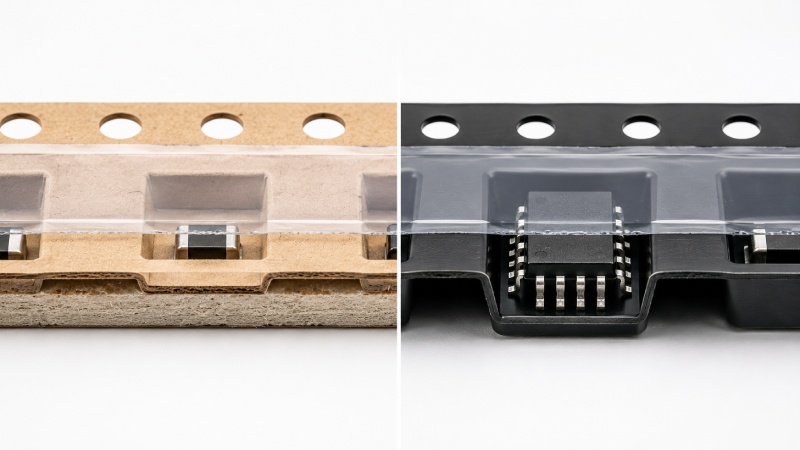
Paper Carrier Tape vs Plastic Carrier Tape
| Selection Factor | Paper Carrier Tape | Plastic Carrier Tape |
|---|---|---|
| Pocket structure | Punched or pressed cavity | Thermoformed or embossed pocket |
| Typical applications | Small, stable, low-profile parts | Wider range of sizes and shapes |
| Pocket depth | More dependent on construction | Better suited to deeper pockets |
| Transparency | Normally opaque | Clear options may be available |
| ESD options | Must be verified by test data | Multiple electrical grades may be available |
| Moisture response | Requires humidity review | Usually less sensitive to humidity |
| Cost potential | Attractive for suitable high-volume parts | Depends on material, pocket, and tooling |
| Sustainability | Depends on coatings and support layers | Depends on polymer and recycling system |
This table is an initial screening tool, not a final specification.
Seven Factors That Should Decide the Material
1. Component Height and Pocket Depth
Pocket depth is one of the first factors to review. A small, flat component may fit securely in a paper cavity, while a taller part may require an embossed plastic pocket.
The pocket must prevent contact with the cover tape without allowing unnecessary movement. A shallow pocket can create compression or sealing problems. An excessively deep pocket may allow tilting or unstable pickup.
2. Shape, Weight, and Center of Gravity
Simple rectangular parts are easier to package than components with terminals, protrusions, fragile surfaces, or uneven weight distribution.
A small component is not automatically suitable for paper tape. A top-heavy or irregular part may rotate during winding or transportation. Plastic tape may provide better control when the pocket needs custom ribs, steps, or wall geometry.
3. Pocket Fit and Component Movement
Pocket dimensions must provide enough clearance for loading and pickup without allowing excessive movement. Important factors include pocket length, width, depth, pitch, and cavity position.
Poor fit can cause rotation, flipping, damaged terminals, missed pickup, or component escape during cover tape peeling.
4. ESD Requirements
Electrical performance must match the sensitivity of the component and the handling environment.
Buyers should not assume paper tape has no ESD capability or that every black plastic tape is conductive. Electrical classification depends on the exact material, treatment, test method, humidity, and specified resistance range.
For ESD-sensitive parts, request test data and confirm whether low-charging, static-dissipative, or conductive performance is required. Carrier tape, cover tape, and reel should be reviewed as one system.
5. Storage and Humidity Exposure
Paper-based materials can respond to temperature and humidity changes. Depending on grade and construction, moisture exposure may affect dimensions, stiffness, flatness, or feeding behavior.
Plastic tape is generally less sensitive to humidity, but it may still deform under heat, pressure, or unsuitable storage.
6. Feeder and Pick-and-Place Performance
Carrier tape must run smoothly through production equipment. Material selection should consider flatness, camber, sprocket-hole accuracy, pocket position, stiffness, and peel behavior.
A tape that passes manual inspection may still create indexing errors or unstable pickup at production speed.
The most reliable qualification method is a feeder trial using representative reels and actual components. Evaluate feeding stability, pickup accuracy, component movement, and line interruptions.
7. Cover Tape and Bottom Support Compatibility
Carrier tape cannot be selected separately from the sealing system. Paper and plastic surfaces may require different cover tapes, seal conditions, and process windows.
Confirm cover tape type, seal width, sealing conditions, peel consistency, and contamination risk. Paper constructions with a bottom support layer also require verification of adhesion and alignment.
Which Components Suit Each Material?
Paper carrier tape is often considered for chip resistors, ceramic capacitors, small inductors, ferrite parts, and other compact passive components. Suitability still depends on height, weight, orientation, and pocket design.
Plastic carrier tape is commonly evaluated for integrated circuits, sensors, LEDs, connectors, switches, and components requiring deeper or more complex pockets. It can also support visual inspection when transparent material is needed.
Some products, including small diodes and unusually shaped passive components, may work with either material. Drawing review, sample loading, sealing trials, and feeder validation should decide the final format.
Is Paper Carrier Tape Always Cheaper?
Paper tape may offer an attractive unit cost for suitable high-volume components, but material price is only one part of the decision.
Buyers should compare tooling, sampling, minimum order quantity, bottom support material, cover tape, reel cost, loading efficiency, scrap, component damage, rework, and production downtime.
A lower-priced tape that causes feeding interruptions may cost more than a higher-priced design that runs reliably. The correct comparison is total packaging cost, not price per meter.
Is Paper Carrier Tape More Sustainable?
Paper carrier tape may help reduce plastic use in suitable applications, but sustainability claims should be based on the complete construction.
Important factors include fibre source, coatings, antistatic treatments, adhesives, bottom layers, manufacturing waste, transport efficiency, and local recycling capability.
Plastic tape also varies by polymer, additives, contamination, and available recycling infrastructure. The responsible approach is to compare material use, packaging performance, waste, and disposal routes together.
How to Qualify the Final Choice
Provide the supplier with the component drawing, exact dimensions, tolerances, weight, orientation, polarity, sensitive surfaces, ESD classification, tape width, reel requirements, and expected volume.
Request a pocket drawing, material specification, dimensional report, pocket-fit sample, sealing trial, winding test, and feeder trial where appropriate.
Final approval should be based on a representative production reel rather than a visual comparison of materials.
Final Decision
Choose paper carrier tape for initial evaluation when the component is small, stable, low-profile, and suitable for a punched or pressed cavity.
Choose plastic carrier tape when the component needs a deeper pocket, complex geometry, greater structural protection, visual inspection, or verified dissipative or conductive performance.
The best carrier tape is not simply the one with the lowest material price. It is the one that protects the component, seals consistently, feeds reliably, and supports an acceptable total packaging cost.
For a practical recommendation, send your supplier the component drawing, sample, ESD requirement, expected volume, and current tape specification. A proper engineering review can determine the appropriate material, pocket structure, cover tape, and reel configuration before mass production.



 Emial
Emial John Mr